Friday, September 15, 2006

IAEA says U.S. report on Iran is 'dishonest'

A recent House of Representatives committee report on Iran's nuclear capability is "outrageous and dishonest" in trying to make a case that Tehran's program is geared toward making weapons, a senior official of the U.N. nuclear watchdog, IAEA (International Atomic Energy Agency), has said.

Not surprising since the Bush administration has been dishonest on more than one occasion during the Iran situation.

The letter, obtained by The Associated Press on Thursday outside a 35-nation board meeting of the IAEA, says the report is false in saying Iran is making weapons-grade uranium at an experimental enrichment site, when it has in fact produced material only in small quantities that is far below the level that can be used in nuclear arms. Via Yahoo News

Wednesday, September 13, 2006

Iran wanted peace, U.S. ignored them

The U.S. has refused to pledge not to attack Iran militarily, despite appeals by Europe for it to do so. Press reports have indicated that the Bush Administration has made extensive and detailed preparations for military strikes against Iran, while the Administration in its public statements has refused to rule out a US military attack.

Even though Iran offered peace with Israel in propsal to U.S. in 2003, the Bush administration obviously didn't care very much since they have their own agenda:

In 2003, Bush refused to allow any response to the Iranian offer to negotiate peace with Israel.

The Iranian proposal also offered to accept much tighter controls by the International Atomic Energy Agency (IAEA) in exchange for "full access to peaceful nuclear technology". It offered "full cooperation with IAEA based on Iranian adoption of all relevant instruments".

As State Department spokesman Sean McCormack told reporters last January, the [Bush] administration didn’t then see “anything that indicates the Iranians are willing to engage in a serious diplomatic process” on the nuclear issue. A complete and totally disgusting fabrication of the truth! Why do we allow this?

The Iranian threat to "wipe Israel off the map" has been a major propaganda theme of the Bush administration for months.

Another unnecessary war could accelerate a cycle of warfare and terror that could plague the world for many years to come. A former official of the International Atomic Energy Agency told reporter Seymour Hersh: “there’s nothing the Iranians could do that would result in a positive outcome. American diplomacy does not allow for it.”

Congress and the media should start to examine and discuss the real reasons for this stubborn rejection of diplomacy, which is rooted in the Bush administration’s aggressive politico-military and imperalistic aims toward Iran and the broader Middle East.

»Tell Congress to oppose President Bush's threats to attack Iran.

Also read "Burnt Offering" article by Gareth Porter

Tuesday, September 12, 2006

Mission Failed: The Taliban Resurgence

With Afghan Opium crops soaring,the highest ever, it's no mystery why the Taliban is resurging in an area called Waziristan on the northwest Afghanistan-Pakistan border.

Troops fighting in Afghanistan face about as much danger as troops in Iraq, says The New York Times . Their investigation concludes that Afghanistan has become "a symbol of failure."

CBS reporter, Lara Logan, has the opportunity to travel deep into Taliban territory after 6 months of negotiations with Taliban leaders.

Logan is taken to a place with scores of Taliban fighters. The fighters are proud to show that they have taken back territory that U.S. forces occupied just 2 years ago.

The following video contains reports from CNN and CBS News.


The International Herald Tribune says,"The war seems, to many fighting it, to have been obscured by the glare of attention on the conflict in Iraq and undercut by the resources it has sapped from this mission."

Europe and Iran Report Progress in Nuclear Talks

Iran and the EU said Sunday that they had made progress in the search for a compromise to avert possible UN sanctions over Iran’s nuclear program. "The meetings … have been productive," said Javier Solana, the EU’s foreign policy chief, after talks with Ali Larijani, Iran’s top nuclear negotiator. "We have clarified some of the misunderstandings that existed before." He added that he wanted to continue the negotiations. "We have made progress," he said. "We want to continue that line, and we are going to meet next week." Larijani said "many misunderstandings had been removed."

The cautious-but-positive tone of the statements from Solana and Larijani contrasted sharply with the US position outlined last week by Nicholas Burns, the under secretary of state for political affairs.

Reuters reported Sunday that Larijani had said Iran would be willing to consider a two-month moratorium on its uranium-enrichment program, but other Iranian officials denied that. Although both sides were unwilling to give many details about the talks, there were suggestions that Iran might be willing to suspend its uranium-enrichment program if negotiations on the package were to start. The US, however, might not accept the idea. NY Times

Will the Bush Admin. attack Iran next?

The Bush administration has already taken a crucial step in weaking Iran by blocking a major Iranian bank. Stuart Levey, the U.S. Treasury's under-secretary for terrorism and financial intelligence is already in Europe for talks this week on how to further limit Iran’s access to the global financial system. This must not happen! This is one of the reasons why Iraq became a place of unrest, the sanctions and the twisted Foreign Policy of the Bush administration.

As Noam Chomsky states, "There are ways to mitigate and probably end these crises. The first is to call off the very credible US and Israeli threats that virtually urge Iran to develop nuclear weapons as a deterrent."

Historical facts are at play here and cannot be disputed.

"Iranians are surely not as willing as the West to discard history to the rubbish heap. They know that the United States, along with its allies, has been tormenting Iranians for more than 50 years, ever since a US-UK military coup overthrew the parliamentary government and installed the Shah, who ruled with an iron hand until a popular uprising expelled him in 1979." says Chomsky. Read full article.

The Bush Administration has talked seriously about the possibility of military strikes against Iran, which could dramatically escalate the level of violence in the region, already high. These threats have undermined real negotiations on Iran's nuclear program. As the Washington Post reported Friday, "The package presented to the [UN Security Council] Thursday provides no explicit assurances Tehran has sought to bar U.S. military strikes on its territory…President Bush…has resisted European appeals to provide Iran with such security assurances, insisting that the military option not be taken off the table." These threats also increase the likelihood of a wider war, a likelihood that seems to increase each day.

Maintaining the threat of a military attack against Iran not only undermines negotiations but also undermines the international regime of nuclear nonproliferation and nuclear inspections, which is based on multilateral cooperation, not unilateral force. Iran is at least 5 to 10 years away from acquiring a nuclear weapon, were it to attempt to do so. There is no crisis justifying the threat of military force against Iran.

Congress should pressure the Bush Administration to take the "military option" of attacking Iran off the table.

We must be pro active and rule out attacks against Iran before it is too late!

Bush Admin. blacklists major Iranian bank

The Bush administration has blacklisted one of Iran's biggest banks, Bank Saderat, alleging that it is used to transfer money to terrorist organizations.

Stuart Levey, the Treasury's under-secretary for terrorism and financial intelligence said the bank had been blacklisted because "this bank, which has approximately 3,400 branch offices, is used by the government of Iran to transfer money to terrorist organisations."

According to Mr Levy, the bank had facilitated the transfer of hundreds of millions of dollars to the Lebanese militant group, Hezbollah, and what he called other terrorist organisations, every year. Via
BBC

We need to stop the U.S. from putting sanctions on Iran, it will force the Iranian people to depend on the Iranian government, making things worse of course. Not to mention the fact that if economic sanctions are imposed on Iran, it may cause 10,000 Germans to lose their jobs.


Monday, September 11, 2006

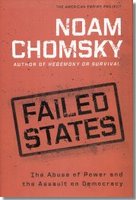
Examining the U.S. as a Failed State

In his new book Failed States, Noam Chomsky, the world's foremost critic of U.S. foreign policy exposes the hollow promises of democracy in U.S. actions abroad -- and at home.

The United States has repeatedly asserted its right to intervene militarily against "failed states" around the globe. In this much-anticipated follow-up to his international bestseller Hegemony or Survival, Noam Chomsky turns the tables, showing how the United States itself shares features with other failed states -- and therefore is increasingly a danger to its own people and the world.

Failed states, Chomsky writes, are those that are unable or unwilling "to protect their citizens from violence and perhaps even destruction" and "regard themselves as beyond the reach of domestic or international law." Though they have have democratic forms, Chomsky notes, failed states suffer from a serious "democratic deficit" that deprives their democratic institutions of real substance. Exploring the latest development in U.S. foreign and domestic policy, Chomsky reveals Washington's plans to further militarize the planet, greatly increasing the risks of nuclear war; assesses the dangerous consequences of the occupation of Iraq, which has fueled global outrage at the United States; documents Washington's self-exemption from international norms. Including the UN Charter and the Geneva Conventions, the foundations of contemporary international law, and examines how the U.S. electoral system is designed to eliminate genuine political alternatives, impeding any meaningful democracy.

Saturday, September 09, 2006

Bush 'new found interest' in bin Laden

Today, the Democratic National Committee released a new video showing the Bush Administration's willingness to use fear and smear tactics to gain political advantage in a tough election year. Specifically, after years of hardly mentioning Osama bin Laden, saying that "he wasn't that concerned about him," and closing down the CIA office charged with his capture, President Bush seemed to have a new found interest, citing the mastermind of the 9/11 attacks seventeen different times in a speech this week.


Source

Saddam saw al-Qaeda as threat

Saddam Hussein regarded al-Qaida as a threat rather than a possible ally, a Senate report says, contradicting assertions President Bush has used to build support for the war in
Iraq. The report also newly faults intelligence gathering in the lead-up to the 2003 invasion.

Released Friday, the report discloses for the first time an October 2005
CIA assessment that prior to the war Saddam's government "did not have a relationship, harbor or turn a blind eye toward" al-Qaida operative Abu Musab al-Zarqawi or his associates.

As recently as an Aug. 21 news conference, Bush said people should "imagine a world in which you had Saddam Hussein" with the capacity to make weapons of mass destruction and "who had relations with Zarqawi."

Via Yahoo News

Thursday, September 07, 2006

Bush and Saddam Should Both Stand Trial, Says Nuremberg Prosecutor

Quite ironic how Bush compared al Qaeda to Nazis. Read on. A chief prosecutor of Nazi war crimes at Nuremberg has said George W. Bush should be tried for war crimes along with Saddam Hussein. Benjamin Ferencz, who secured convictions for 22 Nazi officers for their work in orchestrating the death squads that killed more than 1 million people, told OneWorld both Bush and Saddam should be tried for starting "aggressive" wars--Saddam for his 1990 attack on Kuwait and Bush for his 2003 invasion of Iraq.

"Nuremberg declared that aggressive war is the supreme international crime," the 87-year-old Ferencz told OneWorld from his home in New York. He said the United Nations charter, which was written after the carnage of World War II, contains a provision that no nation can use armed force without the permission of the UN Security Council.

Ferencz said that after Nuremberg the international community realized that every war results in violations by both sides, meaning the primary objective should be preventing any war from occurring in the first place.

He said the atrocities of the Iraq war--from the Abu Ghraib prison scandal and the massacre of dozens of civilians by U.S. forces in Haditha to the high number of civilian casualties caused by insurgent car bombs--were highly predictable at the start of the war.

Full Article at OneWorld US

Disapproval of Bush increases in U.S.

An annual transatlantic survey released Wednesday by Transatlantic Trends had some interesting results. For the first time in its five-year history — shows more Americans disapproving (58%) than approving (40%) of President Bush’s handling of international affairs. That brings the U.S. much closer to reaching the Europeans levels of disapproving (77%) than approving (37%) of President Bush’s handling of international affairs.

More Key Findings

Gingrich urges U.S. to "get tough" with Iran

In an article via FOX News, former House Speaker Newt Gingrich says it's time for the United States to "get tough" with Iran's Islamic theocracy. Speaking before a conservative public policy group Wednesday, Gingrich said Americans should take Iranian leaders'threats seriously, before they acquire nuclear weapons.

However, the threat of a military attack against Iran not only undermines negotiations but also undermines the international regime of nuclear nonproliferation and nuclear inspections, which is based on multilateral cooperation, not unilateral force. Iran is at least a 5-8 years away from acquiring a nuclear weapon, were it to attempt to do so. There is no crisis justifying the threat of military force against Iran.

Gingrich goes on to say, "We have real enemies and they would like to kill us." I couldn't agree with you more, seeing how 30% of Europe says the U.S. is the greatest threat to global stability, and second in line is Iran.

Gingrich also said the United States is paying for former President Clinton's foreign policies, which he said gave Americans"eight years of appeasing the world and provided an opportunity for Osama bin Laden to bomb two U.S. embassies and the USS Cole."

Mr. Gingrich fails to realize that Clinton didn't call other world leaders names or attempt to scare the American public into making irrational decisions. That's one of the main reasons we had peace during the Clinton Administration.