Showing posts with label N. Korea. Show all posts

Monday, February 12, 2007

N. Korea agrees to ditch nukes, Bolton wins Asshole of the Year

Assistant Secretary of State Christopher Hill, the lead American official at the talks, said the United States will give an unspecified amount of energy assistance to North Korea in exchange for North Korea freezing its production of plutonium.

Everything seems to be going great. Right? Until.... John Bolton (militant fuckhead imperialistic piece of shit) makes these remarks, calling the whole thing "a very bad deal."

From CNN: It makes the Bush administration "look very weak, at a time in Iraq and dealing with Iran that it needs to look strong," Bolton told CNN's Wolf Blitzer Monday.

"I'm hoping that the president has not been fully briefed on it and still has time to reject it," he said.

What the hell is wrong with this idiot? Hey, John Bolton, go continue to fuck yourself.

Thursday, November 16, 2006

U.S. may mull pre-emptive Iran strike, and put us in harms way once again

According to Reuters, the United States or other countries will one day be forced to consider pre-emptive action if Iran and North Korea continue to seek nuclear weapons, a senior U.S. government official said on Tuesday.

WEll, I can tell you that if this happens, I am getting out of this country. Wait! We might not be able to leave, remember: When the Department of Homeland Security system comes into effect next January, your U.S. Passport won't matter, if the agency says "no" to a clearance request, or doesn't answer the request at all, you won't be permitted to enter-or leave-the United States. Yay!

But thanks to covert government actions, many citizens don't know this is about to happen.

Wednesday, November 08, 2006

13 nations denounced for web censorship

Belarus, China, Cuba, Egypt, Iran, Myanmar, North Korea, Saudi Arabia, Syria, Tunisia, Turkmenistan, Uzbekistan and Vietnam have all censored the web in some way.

Reporters Without Borders (RWB) claims these nations are the worst culprits for systematic online censorship, and they were targeted in the group's 24-hour online protest. No one should ever be prevented from posting news online or writing a blog," said the Paris-based group, and I agree.

In an annual report, the group said 61 people worldwide, 52 in China, are in prison for posting what the countries claimed was "subversive" content.

RWB obtained a copy of the verdict in the case of Jiang Lijun, sentenced to 4 years in prison in Nov. 2003 for his online pro-democracy articles in China. RWB said that Yahoo! had helped Chinese police identify him. 200 people have already recorded a message for the founder of Yahoo!, deploring the fact that his company helps the Chinese authorities track down cyber-dissidents.

Nepal, Maldives and Libya have been removed from Reporters Without Borders' annual list of Internet enemies. But there's an addition to the list, Egypt, where it said "many bloggers were harassed and imprisoned this year." What do you think?

Via Newsvine

Friday, November 03, 2006

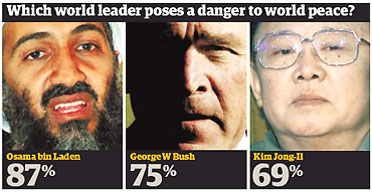
Bush is more dangerous than Kim Jong-il

We saw this in the beginning of September when a poll showed European's think the U.S. is the greatest threat to global security.

Research here shows that British voters see George Bush as a great danger to world peace, more of a threat than even North Korean leader, Kim Jong-il, or the Iranian president, Mahmoud Ahmadinejad. Axis of Evil? Hmmm.

The survey has been carried out by the Guardian in Britain and leading newspapers in Israel (Haaretz), Canada (La Presse and Toronto Star) and Mexico (Reforma), using professional local opinion polling in each country.

This exposes high levels of distrust. In Britain, 69% of those questioned say they believe US policy has made the world less safe since 2001, with only 7% thinking action in Iraq and Afghanistan has increased global security.

The finding is mirrored in Canada and Mexico, with 62% of Canadians and 57% of Mexicans saying the world has become more dangerous because of US policy. Even in Israel, only one in four Israeli voters say that Bush has made the world safer, outweighed by the number who think he has added to the risk of international conflict, 36% to 25%. A further 30% say that at best he has made no difference.

Voters in three of the four countries surveyed also overwhelmingly reject the decision to invade Iraq, with only Israeli voters in favour, 59% to 34% against. Opinion against the war has hardened strongly since a similar survey before the US presidential election in 2004.

In Britain 71% of voters now say the invasion of Iraq was unjustified, a view shared by 89% of Mexicans and 73% of Canadians. Voters don't think America has helped advance democracy in developing countries either, one of the justifications for deposing Saddam Hussein. Only 11% of Britons and 28% of Israelis think that has happened.

In the eyes of UK voters: 87% think bin Laden is a great or moderate danger to peace, compared with 75% who think this of Bush. That's a pretty close call.

Bush is seen in Britain as a more dangerous man than the president of Iran (62% think he is a danger), the North Korean leader (69%) and the leader of Hizbullah, Hassan Nasrallah (65%).

Full article via Guardian Unlimited

Tuesday, October 17, 2006

Sanctions always a dangerous deadend for U.S.

The U.N. sanctions against North Korea for its nuclear test are a declaration of war, and the country will "deal merciless blows" if the nation's sovereignty is violated, the North's central government said Tuesday in its first response to the U.N. measures. Thanks U.S./UN! This recent news brings me to the point that Sanctions against other countries have always turned out bad for the U.S and our reputation throughout history. Period.

The North wants "peace but is not afraid of war," says N. Korea's Foreign Ministry. And so have said many previous nations that have been dealt harsh sanctions by the U.S. and it's minions throughout history.

When the U.S. placed sanctions on countries like Cuba and Iraq, they did more damage than good. In Cuba, the people are forced to confide in Castro and to flee the country. The same was the result of harsh sanctions against Iraq, people forced to trust and obey Saddam, and deterioration of their economy.

All resulting in very angry and pissed of people around the world (some a.k.a. terrorists).
“The number of Iraqi people who have died in the last eight years as a result of the sanctions exceeds the death toll due to all the weapons of mass destruction used in human history,” said Noam Chomsky to MIT's 'The Tech' in April 1999. And Pat Buchanan states, "sanctions may have caused the deaths of 500,000 [Iraqi] children. When Madeleine Albright, Secretary of State under President Clinton was asked if this horrific toll of Iraqi children was justified, she replied, 'We believe the price is worth it.' "

In the case of Iran, we are again warned by Mohamed ElBaradei (IAEA cheif) back in March, that Iran is not an imminent and sanctions against them is a "bad idea" and "we need to lower the pitch."

The sanctions imposed by the U.S. also deals hard blows to our domestic economy, as "...
firms and workers in the United States also pay an immediate price when [sanctions are brought against other nations]. Even though the aggregate cost in relation to our GDP is usually very small, the costs may be significant for individual firms or industries." This is one of the facts that Jeffrey Schott, of the Institute for International Economics, stated to the Committee on International Relations at the House of Representatives on June 3, 1998. We are also told this by Richard Haass of The Brookings Institute, "...often sanctions turn out to be little more than expressions of U.S. preferences that hurt American economic interests without changing the target's behavior for the better."

Thursday, October 12, 2006

Serious Intelligence Failure on N. Korean Nukes

Bill Gertz reports that the intelligence community has seriously botched its forecasts on North Korea's nuclear weapons program.

Recent U.S. intelligence analyses of North Korea’s nuclear and missile programs were flawed and the lack of clarity on the issue hampered U.S. diplomatic efforts to avert the underground blast detected Sunday, according to Bush administration officials.

Some recent secret reports stated that Pyongyang did not have nuclear arms and until recently was bluffing about plans for a test, according to officials who have read the classified assessments. The analyses in question included a National Intelligence Estimate a consensus report of all U.S. spy agencies produced several months ago and at least two other classified reports on North Korea produced by senior officials within the office of the Director of National Intelligence John D. Negroponte. The officials said there were as many as 10 failures related to intelligence reporting on North Korean missile tests and the suspected nuclear test that harmed administration efforts to deal with the issue.

According to officials familiar with the reports, the failures included judgments that cast doubt about whether North Korea’s nuclear program posed an immediate threat, whether North Korea could produce a militarily useful nuclear bomb, whether North Korea was capable of conducting an underground nuclear test and whether Pyongyang was bluffing by claiming it could carry one out.

The failures would be the latest in a string suffered by U.S. intelligence in recent years, as described in a series of government and nongovernment reports. Past stumbles have included missing chances to detect or stop the September 11 attacks, faulty assessments of Saddam Hussein’s weapons programs, the failure to predict the 1998 round of nuclear tests by India and Pakistan, and overly optimistic predictions of the Iraqi reaction to a U.S. invasion.

Wednesday, October 11, 2006

Rumsfeld gave North Korea nukes

Rumsfeld was the only American to sit on the board of a company which six years ago sold two light water reactors to North Korea. The Guardian reported in May 2003:

Rumsfeld was a non-executive director of ABB, a European engineering giant based in Zurich, when it won a $200m contract to provide the design and key components for the reactors. The current defense secretary sat on the board from 1990 to 2001, earning $190,000 a year.

Rumsfeld has never acknowledged that he knew the company was competing for the nuclear contract. In response to questions about his role in the reactor deal, former Pentagon spokeswoman Victoria Clarke told Newsweek in February 2003 that “there was no vote on this” and that her boss “does not recall it being brought before the board at any time.” But an investigation by Fortune magazine revealed that Rumsfeld probably did know:

ABB spokesman Bjoern Edlund told Fortune magazine at the time that “board members were informed about this project.” … “This was a major thing for ABB,” the former director [who sat on the board with Rumsfeld] said, “and extensive political lobbying was done.” The director recalls being told that Rumsfeld was asked “to lobby in Washington” on ABB’s behalf. … Although he couldn’t provide details, Goran Lundberg, who ran ABB’s power-generation business until 1995, says he’s “pretty sure that at some point Don was involved,” since it was not unusual to seek help from board members “when we needed contacts with the U.S. government.”


Rumsfeld has since refused media requests to talk about his role in the light water reactor deal and has instead criticized it.

Via ThinkProgress Video via Impolitical Also read the Guardian's article